Quick Answer
E6013 can perform effectively on suitable light-gauge carbon steel sheet when using smaller core diameters and controlled low-amperage technique to prevent burn-through. Performance depends on actual sheet thickness, joint design, gap uniformity, and power-source stability. Rather than relying on generic classification claims, buyers should evaluate specific manufacturer datasheets and conduct trial welds on representative production assemblies.
Key Takeaways
- Smaller diameters such as 2.0 mm or 2.4/2.5 mm help limit heat input on thin sheet.
- Joint gap and fit-up consistency affect thin-sheet results more than consumable classification alone.
- Minimum AC open-circuit voltage and polarity settings differ between specific E6013 product brands.
What Makes Thin Sheet Hard to Weld?
Light-gauge carbon steel sheet has limited mass to absorb arc heat. Excessive arc energy or prolonged travel can instantly burn through the base metal or create severe panel distortion. A wide or uneven joint gap makes burn-through significantly worse regardless of consumable choice.
Joint design directly alters heat dissipation: lap joints, corner joints, and butt seams behave differently on identical nominal sheet gauges. Many sheet-metal products rely on short, intermittent tack and stitch welds, making arc striking and restart smoothness as critical as steady-state bead behavior.
| Variable | Risk on light-gauge steel | Workshop control |
|---|---|---|
| Fit-up and joint gap | Wide gaps cause immediate burn-through | Clamp parts tightly; maintain tight, uniform seams. |
| Electrode diameter | Large rods deliver excessive heat input | Select smaller 2.0 mm or 2.4/2.5 mm core sizes. |
| Joint geometry | Butt seams overheat faster than lap joints | Qualify current and travel speed on actual joints. |
Which E6013 Product and Diameter Should Be Tested?
Consult the manufacturer’s exact product datasheet for diameter-specific amperage tables and polarity options. For example, Lincoln Fleetweld 37 publishes operating rows for 2.0 mm (50–80 A on AC, 45–75 A on DC) and 2.4 mm (75–115 A on AC, 70–105 A on DC). Other global manufacturers supply 2.5 mm diameters with distinct operating bands.
Check power-source electrical characteristics before ordering. While Fleetweld 37 is formulated for low-amperage operation on compact AC welders, products like ESAB Weld 6013 specify a minimum 50 V AC open-circuit voltage. These specific electrical requirements belong to individual branded formulations, not to the broad AWS A5.1 E6013 classification as a whole.
What Should a Representative Trial Measure?
Conduct trial runs using actual production sheet thicknesses, clamping fixtures, and available shop power sources rather than flat test coupons on heavy plate. Test both initial striking and repeated restarts on short seam welds to ensure that arc initiation is smooth without blowing through thin edges.
Measure the percentage of welded parts that pass visual inspection without distortion or required repair. If even the smallest practical stick electrode produces excessive heat on delicate joints, consult a welding engineer to assess whether alternative processes like GMAW or GTAW are more appropriate for production.
What Should Buyers Ask in a Sheet-Metal RFQ?
RFQ checklist:
- Steel grade and exact sheet gauge: define measured thickness rather than vague terms.
- Joint configurations and fit-up tolerances: specify corner, lap, or butt joint details.
- Welding machine type, polarity, and OCV: ensure low-amperage arc stability.
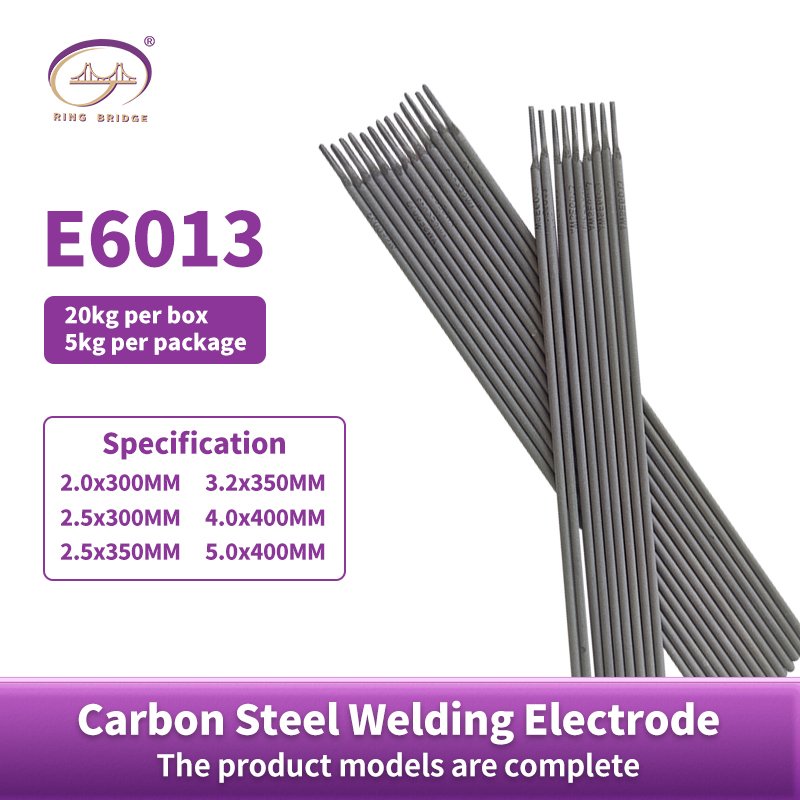
- Exact E6013 brand name and smaller core sizes: request 2.0 mm or 2.4/2.5 mm options.
- Manufacturer technical operating sheet: check published current ranges per polarity.
- Trial sample cartons and inspection criteria: test burn-through and distortion resistance.
Buyer FAQ
Is E6013 better than E6010 for light-gauge sheet?
Yes. E6013’s gentler rutile arc is much less likely to burn through thin metal than E6010’s penetrating cellulosic arc.
Can a 3.2 mm E6013 rod weld 1.0 mm sheet steel?
Generally no. A 3.2 mm rod requires too much current; 2.0 mm or 2.4/2.5 mm rods are standard for light gauges.
Does a smooth plate weld prove thin-sheet suitability?
No. Thin sheet dissipates heat much more slowly than heavy plate and must be tested directly.
Inquiry: Share your sheet gauge, joint drawings, welder specifications, and target volume through your established inquiry route for datasheets, samples, and quotations.
Request a Wholesale Quote:Whatsapp : (+86 15632245103) E-mail : ganzhedao@gmail.com